
Leaving a job is rarely just about handing over your laptop and completing exit formalities. For most salaried employees, it also triggers financial questions that don’t always have clear answers. One of the most common concerns revolves around provident fund savings and, more specifically, EPF Account Interest Rules. People want to know whether their PF money continues to grow after resignation or if it simply sits idle once contributions stop. Understanding EPF Account Interest Rules has become even more important in 2025, as job switches, career breaks, freelancing, and sabbaticals are now far more common than they were a decade ago. If you are planning to quit your job, are already between roles, or are unsure about your next move, knowing how EPF interest works can help you make smarter financial decisions and avoid losing out on long-term returns.
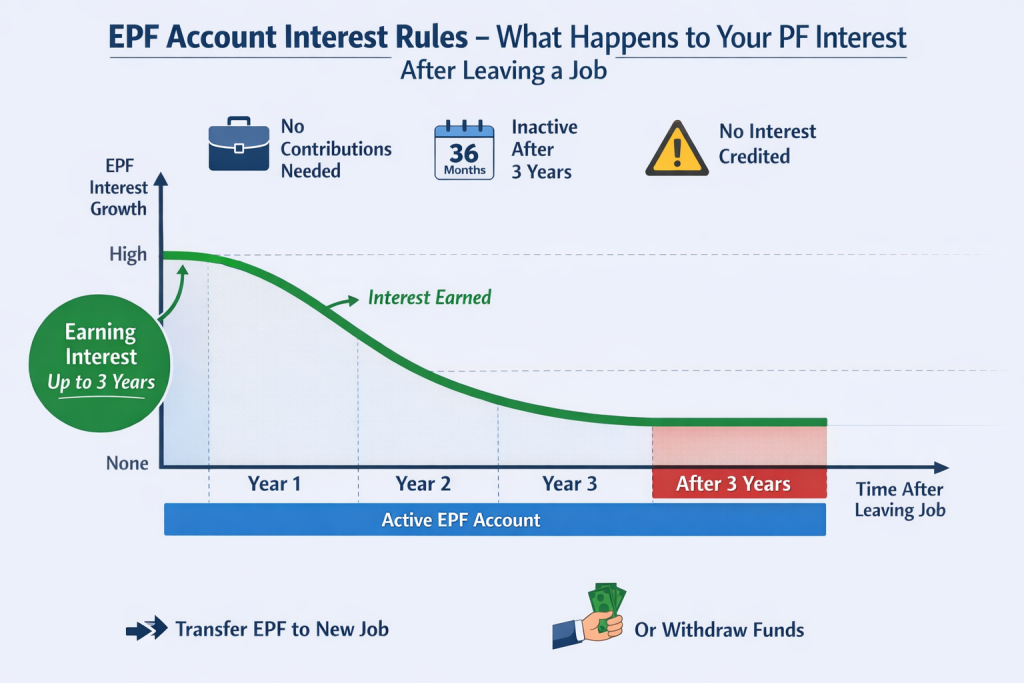
The EPF Account Interest Rules define how long your provident fund continues to earn interest once you leave your job. Contrary to popular belief, your EPF account does not become inactive immediately after resignation. Even if no new contributions are made, EPFO allows interest to be credited for a specific period. This provision exists to support employees during job transitions or temporary unemployment. However, this benefit is time-bound. If you neither withdraw nor transfer your EPF within the allowed period, the account becomes inoperative, and interest stops. Understanding this timeline is crucial to ensuring your retirement savings continue to grow instead of stagnating.
EPF Account Interest Rules
| Key Aspect | Details |
|---|---|
| Interest after resignation | Continues for up to 3 years |
| New contributions required | No |
| Account status after 36 months | Inoperative |
| Interest on inoperative account | Not credited |
| Best financial move | Transfer EPF to new employer |
| Full withdrawal eligibility | After 2 months of unemployment |
| Tax impact | Depends on total service period |
Does PF Earn Interest After Quitting Job
- Yes, your EPF balance continues to earn interest even after you quit your job. As per EPF Account Interest Rules, interest is credited for up to three years from the month of your last contribution. This means that even if you are unemployed, taking a break, or preparing for competitive exams, your EPF savings continue to grow during this period.
- Many employees wrongly assume that interest stops the moment their salary stops. In reality, EPFO provides this grace period to ensure employees are not penalized for short-term career gaps. However, this does not mean you should ignore your EPF indefinitely.
When Does PF Account Become Inactive
- An EPF account becomes inactive if there are no contributions for 36 consecutive months and no withdrawal or transfer request is made during this period. Once this threshold is crossed, the account is classified as inoperative.
- Under EPF Account Interest Rules, an inoperative account does not earn any interest. While the money remains safe with EPFO, it no longer grows. This can significantly affect your retirement corpus, especially if you have accumulated a substantial balance over the years.
Will Interest Be Paid on Inactive EPF Account
- No, interest is not paid once an EPF account becomes inoperative. Even though you can still claim or transfer the funds at a later date, the balance will remain stagnant during the inactive period.
- This is one of the biggest financial downsides of ignoring your EPF after leaving a job. Over time, the loss of compound interest can add up to a sizeable amount, reducing the overall value of your retirement savings.
What Should You Do With EPF After Leaving a Job
- If you join a new company, transferring your EPF balance is the most sensible option. Once transferred, contributions resume and interest continues without interruption. Thanks to the UAN system, this process can now be completed online with minimal paperwork.
- If you do not plan to work for an extended period, you may consider withdrawing your EPF after two months of unemployment. However, EPF Account Interest Rules are structured in a way that favors long-term savings, making transfer a better option for most employees.
EPF Withdrawal Rules After Job Change
- An employee can apply for full EPF withdrawal after remaining unemployed for at least two months. Partial withdrawals may also be allowed under specific conditions such as medical emergencies, home purchase, or education.
- That said, withdrawing EPF should be a carefully considered decision. EPF is designed as a retirement savings instrument, and frequent withdrawals can weaken your long-term financial security.
Tax Rules on EPF Withdrawal
- Taxation of EPF withdrawals depends on your total period of service. If your continuous service is five years or more, the withdrawal is completely tax-free. If it is less than five years, the withdrawn amount may be taxable, and TDS may apply.
- Interest earned during the eligible period is also subject to tax rules. This is another reason why understanding EPF Account Interest Rules before withdrawing your funds is extremely important.
Why You Should Not Ignore EPF After Resignation
- Ignoring your EPF after quitting a job can lead to several avoidable issues. You may lose interest after three years, face tax complications, or experience delays during future claims. Many people only realize these problems years later when they actually need the money.
- Your EPF is one of the safest long-term savings tools available, backed by the government. Treating it casually can undermine its purpose and reduce your financial stability in the future.
Common Mistakes Employees Make with EPF After Quitting
- One common mistake is assuming EPF will earn interest forever without action. Another is withdrawing funds immediately without considering tax implications or long-term goals. Some employees also forget to update KYC details, which can delay transfers or withdrawals.
- Being aware of EPF Account Interest Rules helps you avoid these mistakes and make informed choices that align with your financial plans.
Senior Citizen New Benefits 2026 – 8 New Facilities Begin January 7, Check Who Qualifies
Key Takeaways on EPF Interest After Quitting Job
- The rules around EPF interest are simple but often misunderstood. Your EPF continues to earn interest for three years after resignation, even without contributions. After that, the account becomes inactive and interest stops.
- To protect your savings, you should either transfer your EPF to your new employer or withdraw it within the permitted timeframe if you do not plan to work again. Staying proactive with your EPF ensures that your hard-earned money continues to grow and supports you in the long run.
FAQs on EPF Account Interest Rules
Does EPF Earn Interest If I Am Unemployed
Yes, EPF earns interest for up to three years after the last contribution, even if you are unemployed.
How Long Can I Keep EPF Without A Job
As per EPF Account Interest Rules, interest is credited for 36 months after contributions stop.
Is It Better to Withdraw or Transfer EPF
For long-term financial growth and tax efficiency, transferring EPF is usually the better option.
Will I Lose My EPF Money If the Account Becomes Inactive
No, the money remains safe, but it will stop earning interest until claimed or transferred.