
If you’ve been searching for a safe place to park your money in 2025, you’ve probably seen people talking about LIC FD Special Schemes everywhere. The reason is simple many investors want steady, predictable returns without worrying about daily market ups and downs, and this type of deposit-style product fits that mindset nicely. At the same time, there’s a lot of confusion around the term LIC FD. In many online posts, LIC FD is used as a phrase for deposit schemes linked with LIC Housing Finance (LIC HFL), not a traditional LIC insurance policy. So, before you invest, it’s important to understand exactly what product you’re looking at, what your payout will look like, and what rules apply if you need money early.

When people mention two new plans under LIC FD Special Schemes, they’re usually talking about the two common deposit formats offered within the same deposit framework. This structure is popular because it lets you match your investment with your personal goal. If you want monthly income, you’d typically lean toward non-cumulative. If you’re building a bigger maturity corpus, cumulative can be more suitable.
LIC FD Special Schemes Overview Table
| Overview Point | Details |
|---|---|
| Title | LIC FD Special Schemes |
| Scheme Type | Deposit style plan under LIC Housing Finance deposit framework |
| Two Plans Meaning | Cumulative option and Non-Cumulative option |
| Who It Suits Best | Conservative investors, retirees, people who want predictable returns |
| Tenure Range | Typically 1 year to 5 years with multiple duration choices in between |
| Interest Payout Options | Monthly / Quarterly / Annual (Non-Cumulative), Maturity payout (Cumulative) |
| Senior Citizen Benefit | Extra interest benefit may be available for senior citizens |
| Minimum Deposit | Depends on payout option (monthly payout often has higher minimum) |
| Premature Withdrawal | Possible, but rules and interest impact apply |
| Loan Against Deposit | May be available up to a certain percentage of deposit value |
Repayment in LIC FD Special Schemes
One of the most practical things about LIC FD Special Schemes is the repayment flow. Your maturity amount is typically paid to your registered bank account, so the money comes back to you without needing repeated follow-ups assuming your KYC and bank details are correct.
Here’s how repayment usually works in simple terms:
- If you chose Cumulative: You receive the principal plus accumulated interest at maturity.
- If you chose Non Cumulative: You receive regular interest payouts during the tenure, and the principal is returned when the deposit matures.
If your priority is predictable monthly cash flow for household expenses, a non-cumulative monthly payout tends to be the more comfortable fit. But if your goal is to create a lump sum for a future plan like a child’s education fund, a home renovation budget, or a large, planned purchase cumulative may feel more aligned.
Renewal of LIC FD Special Schemes
Renewal is a feature many investors overlook, but it matters. If you want to continue after maturity, renewal may allow the deposit to roll over into a fresh term usually at the prevailing interest rate at that time.
A smart way to handle renewal is:
- Set a reminder 2–3 weeks before maturity.
- Compare current deposit rates across similar safe instruments.
- Decide whether to renew, switch the payout type, or move to another option.
This helps you avoid auto decisions with your money and keeps your returns aligned with current market conditions.
Premature Withdrawal
This is where many people get surprised later so it’s better to be clear now. Premature withdrawal (closing the deposit before maturity) may be allowed, but it usually comes with conditions. In many deposit products, early closure can mean:
- Reduced interest rate compared to the original promised rate, or
- No interest for very short holding periods, or
- A penalty-type adjustment depending on how early you exit
So if you’re considering LIC FD Special Schemes, try to invest money you can genuinely lock in for the chosen tenure. Keep your emergency fund separate, ideally in a highly liquid option like a savings account, sweep FD, or short-term liquid investment that you can access quickly.
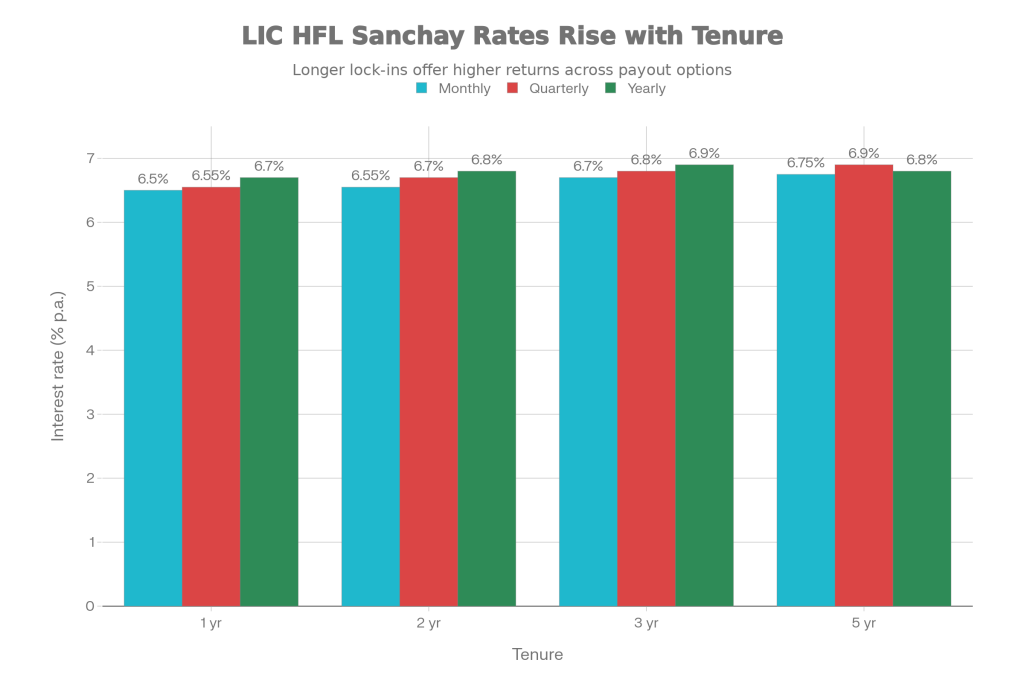
LIC Fixed Deposit Interest Rates Effective from June 2025
Interest rates are one of the biggest reasons people search for LIC FD Special Schemes. But here’s the key rates usually depend on three things:
- Tenure you pick (1 year, 2 years, 3 years, 5 years, etc.)
- Payout type (monthly/quarterly/annual vs cumulative)
- Investor category (general vs senior citizen, if extra benefit applies)
In many deposit schemes, monthly payout rates can differ slightly from annual payout rates because the cash is being paid out sooner rather than being retained. Likewise, longer tenures sometimes offer better rates, though that’s not always guaranteed.
Practical tip: If your aim is regular income, don’t just look at the headline interest rate also estimate the actual monthly interest you will receive after taxes and TDS rules, if applicable.
Points To Note
Before you invest in LIC FD Special Schemes, keep these real-world checks in mind. These are the things that make the difference between a good on paper decision and an actually smooth experience:
- Clarify what product it is: Many people assume LIC FD means LIC insurance. It often refers to deposit products linked with LIC Housing Finance deposits.
- Match payout to purpose: Monthly payout is great for income; cumulative is good for maturity corpus.
- Minimum deposit can vary: Monthly payout options often come with higher minimum deposit requirements than annual/cumulative options.
- TDS and tax impact: Interest from deposits is generally taxable. The effective return depends on your tax slab.
- Nomination is important: Always add a nominee. It saves your family major headaches later.
- Don’t ignore liquidity: Lock-in style instruments should not be your emergency fund.
If your goal is stability, LIC FD Special Schemes can be worth considering but only after comparing the net returns and understanding the exit rules.
How To Choose The Right Option
If you’re stuck between cumulative vs non cumulative, this quick decision framework helps:
Monthly Income Need
Go with non-cumulative monthly payout if:
- You want a steady income stream.
- You’re retired or supporting household monthly expenses.
- You prefer “cash-in-hand” returns instead of waiting for maturity.
Lump Sum Goal
Go with Cumulative if:
- You want to build a bigger amount by maturity.
- You don’t need regular payouts.
- You’re planning for a future expense after a fixed timeline.
Balanced Approach
Many smart investors split the investment:
- A portion in non cumulative for income
- A portion in cumulative for long-term corpus
This reduces dependence on a single payout style and gives flexibility.
Common Mistakes Investors Make
Even smart investors sometimes slip on small details. Avoid these:
- Investing without checking premature withdrawal rules.
- Selecting monthly payout without noticing the higher minimum deposit requirement.
- Ignoring the tax effect and overestimating real returns.
- Not aligning tenure with actual cash needs.
- Not comparing with other safe alternatives (bank FD, post office schemes, debt instruments based on risk appetite).
When done thoughtfully, LIC FD Special Schemes can sit nicely in the safe allocation part of your portfolio.
FAQs on LIC FD Special Schemes
What Is LIC FD Special Schemes Actually?
LIC FD Special Schemes usually refers to deposit-style options offered under LIC Housing Finance’s deposit framework, commonly discussed online as “LIC FD”.
Which Is Better Cumulative or Non-Cumulative?
If you want monthly or periodic income, non-cumulative is generally preferred. If you want a higher maturity value through compounding and don’t need payouts, cumulative can be better.
Can Senior Citizens Get Higher Returns?
In many deposit schemes under this framework, senior citizens may receive an additional interest benefit over the regular card rate.
Is Premature Withdrawal Allowed?
Premature withdrawal may be possible, but it can impact the interest you earn, depending on how early you exit and the rules of the product.