
Electricity bills in India don’t just feel higher these days they are higher, and power cuts in many areas still make daily life inconvenient. That’s why rooftop solar has moved from a nice idea to a practical home upgrade. The buzz around ₹500 rooftop solar is everywhere, but here’s the real story: the government scheme isn’t about getting an entire solar system for ₹500. The real value comes from subsidy support, an online application process, and long-term savings through net metering and self-consumption. If you’re considering rooftop solar in 2025, this topic is worth your attention because it’s not just about cutting one month’s bill. It’s about locking in predictable energy costs for years, reducing dependency on the grid, and using a system that can keep paying you back month after month. When you choose the right system size, work with the right vendor, and complete the DISCOM steps properly, rooftop solar becomes one of the most financially sensible upgrades for a home.

Solar Panel Yojana 2025 is commonly used as a broad search term for India’s rooftop solar push under PM Surya Ghar Muft Bijli Yojana. The goal is simple: help households install grid-connected rooftop solar with subsidy support so families can produce their own electricity and reduce monthly bills. The “₹500” angle is often linked to small registration or processing charges shown in ads by third parties, but your real savings come from the subsidy and the electricity you generate over the long term. Think of Solar Panel Yojana 2025 as a structured path to rooftop solar rather than a discount coupon. Your actual outcome depends on three things: picking the right capacity, completing DISCOM feasibility and inspection smoothly, and installing through an approved vendor who does proper documentation for net metering and subsidy. Done right, it’s a long-term power solution, not a short-term offer.
Solar Panel Yojana 2025
| Particulars | Details |
|---|---|
| Scheme Name | PM Surya Ghar Muft Bijli Yojana (Rooftop Solar Scheme) |
| Target Users | Residential households in India |
| Main Benefit | Rooftop solar installation with subsidy support |
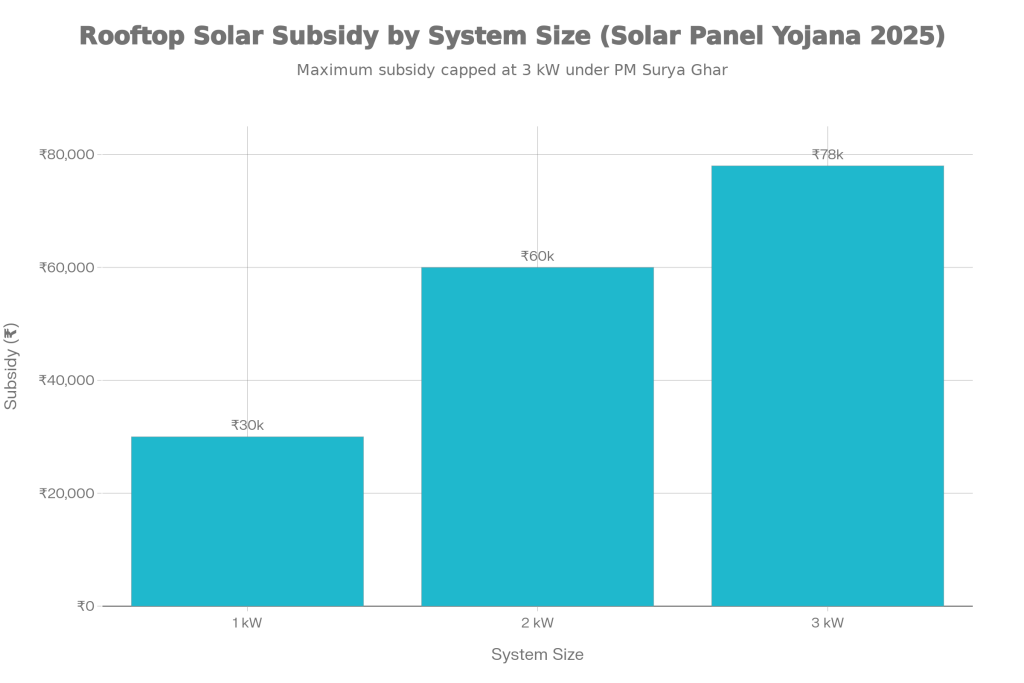
| Subsidy Range | ₹30,000 to ₹78,000 (capacity-based) |
| Subsidy Cap | Up to 3 kW (subsidy capped) |
| Electricity Benefit Claim | Up to 300 units per month (as communicated under the scheme) |
| Application Mode | Online via national portal |
| Key Dependencies | DISCOM feasibility, vendor selection, inspection, net metering |
| Support Option | Helpline available for guidance |
PM Surya Ghar Muft Bijli Yojana is the government’s flagship effort to accelerate rooftop solar adoption among residential consumers. It’s designed to make solar more affordable and more accessible by using a portal-based application process, DISCOM verification, and subsidy transfer mechanisms. Instead of treating solar like a complex engineering project, the scheme frames it as a guided, step-by-step process for households. When most people search Solar Panel Yojana 2025 online, they are essentially looking for this scheme. The important thing is to separate genuine scheme benefits from marketing noise. The scheme’s strength lies in subsidy support and a defined workflow, but your real experience will depend on execution: feasibility approval timelines, vendor quality, installation standards, and net metering completion.
Solar Panel Yojana 2025 Key Highlights
- The biggest highlight is that the subsidy is capacity-based and can significantly reduce your upfront cost. A second key point is that the application process is digital, which usually improves transparency and tracking. And third, net metering can make the economics far more attractive because excess generation can translate into bill credits, depending on your state’s policy and DISCOM rules.
- Another underrated highlight is that this is not just installation. A proper rooftop solar setup involves approvals, inspection, commissioning, and compliant wiring and safety protections. If you treat it casually you risk delays or poor performance. If you treat it like a serious home asset, you get serious long-term benefits.
Subsidies For Installing Solar Panels
- The subsidy structure is designed to encourage adoption while keeping public support balanced. In practical terms, the subsidy increases with system size only up to a point, and then it’s capped. The widely discussed cap is up to 3 kW for subsidy calculations, meaning that if you install a higher capacity system, subsidy may still be calculated only up to the capped limit.
- For homeowners, the takeaway is simple: don’t select capacity based only on subsidy. Select it based on your electricity consumption and payback logic. Also remember that subsidy is typically linked to compliant installation and documentation. If your vendor doesn’t complete paperwork properly or your inspection doesn’t clear on time, your subsidy timeline can be affected.
The Suitable Rooftop Solar Plant Capacity For Households Is As Follows
- Choosing the right system size is where most savings are won or lost. A smaller system may not meaningfully reduce your bill, while an oversized system can stretch payback unnecessarily if your usage pattern doesn’t match generation. The smarter approach is to look at your last 10 to 12 months of bills, calculate your average monthly units, and then decide capacity based on realistic usage.
- As a practical rule of thumb, households with low monthly consumption can often do well with a smaller capacity. Moderate consumption homes, especially those with seasonal AC use and typical appliances, may benefit from mid-range capacity. High consumption homes with multiple ACs or high day-time usage might prefer larger systems, but you should factor in the subsidy cap and how net metering works in your area.
- A useful tip is to check your day-time load. Solar produces power in daylight hours, so the more you consume directly during the day, the higher your immediate savings. Net metering helps, but self-consumption is usually the most efficient value driver.
The Subsidy for Group Housing Society (GHS) Resident Welfare Association (RWA)
- If you live in an apartment complex or a gated society, individual rooftops may be limited. That’s where society-level solar becomes a strong option. A Group Housing Society or Resident Welfare Association can plan solar for common area loads like lifts, corridor lighting, water pumps, security systems, and club facilities. Many societies are also exploring solar-linked EV charging to make the infrastructure future-ready.
- The advantage of a society model is scale. Bulk procurement can improve pricing, maintenance contracts can be negotiated better, and performance monitoring can be implemented centrally. The challenge is coordination: approvals, vendor due diligence, and clarity on metering and billing mechanics. If the committee manages the project professionally, society solar can deliver consistent savings over the long run.
The Solar Rooftop Scheme Offers The Following Benefits
- The obvious benefit is a lower electricity bill, but rooftop Solar’s real strength is long-term stability. When grid tariffs rise over the years, your solar-generated electricity cost remains relatively stable, creating a natural hedge against price increases. That predictability alone makes a big difference for families trying to manage monthly expenses.
- Key benefits you can expect include lower monthly bills, potential bill credits through net metering (subject to rules), cleaner energy use, and in some cases, a positive impact on property appeal. Rooftop solar also encourages better energy habits because many homeowners start tracking consumption and generation more closely once they install a monitoring app.
Applicants Must Meet the Following Conditions to Apply
- Eligibility is kept fairly straightforward so that genuine households can benefit without excessive complexity. Typically, you should be an Indian citizen, own the property, have a suitable rooftop, and have a valid electricity connection. If you have already claimed solar subsidy benefits under another scheme, your eligibility may be affected.
- Before you apply, keep your electricity consumer details ready and make sure your bank account details are correct to avoid subsidy transfer issues. It’s also wise to assess rooftop shading. Heavy shade from nearby buildings, water tanks, or trees can reduce generation and weaken your payback.
Photovoltaic Panels, Also Known as Rooftop Solar Panels, Are Installed
- Photovoltaic panels convert sunlight into electricity and are installed on your rooftop using a mounting structure designed to handle wind load and weather conditions. A typical grid-connected solar system includes panels, an inverter, mounting structure, wiring, safety protections, earthing, and a bidirectional meter for net metering.
- Quality matters because rooftop solar is a long-life asset. A cheap installation with poor wiring or weak mounting can create safety risks and reduce performance. Inverter reliability is especially important, because the inverter is the “brain” that converts DC electricity into usable AC power for your home and syncs with the grid.
- If you want the long-term benefits promised by Solar Panel Yojana 2025, don’t compromise on basic engineering standards, warranties, and after-sales support.
The Entire Process Is More Financially Sound Via Net Metering
- Net metering is what makes rooftop solar financially stronger for many households. Your meter accounts for electricity you import from the grid and electricity you export when your solar system produces more than you use. Depending on DISCOM and state rules, exported units can reduce your bill through credits or adjustments.
- Net metering improves economics because it reduces wastage of excess generation, helps manage seasonal generation changes, and can shorten the payback period. Still, the exact benefit depends on your policy environment. That’s why you should confirm net metering availability, meter installation timelines, and billing rules with your DISCOM or vendor before you finalize your system.
Below Are the Steps to Apply for Pm Surya Ghar Muft Bijli Yojana
- The overall process typically looks like this. First, you register on the portal and submit basic details along with your electricity consumer number. Next, the DISCOM checks feasibility, and once it’s approved, you choose an approved vendor for site survey and installation. After installation, DISCOM inspection and commissioning happen, and then net metering is completed. Finally, the subsidy claim process is initiated and the subsidy is transferred through DBT, subject to successful completion of the workflow.
- A practical tip: insist on a written scope of work from the vendor. It should clearly include component brands, warranty terms, safety protections, earthing, monitoring app access, net metering support, and post-installation service commitments. This one step prevents most headaches later.
Subsidy Directly to the Beneficiary’s Bank Account Within 30 Days
- Many homeowners focus heavily on the subsidy timeline, and rightly so. The transfer typically depends on successful installation, inspection approval, and correct documentation. If any detail is wrong, the timeline can stretch.
- Common reasons for delays include incorrect bank details, mismatch in consumer name and connection details, incomplete commissioning documents, vendor delays in portal updates, and inspection backlogs. If you want things to move smoothly, be proactive: keep copies of all documents, confirm portal updates, and follow up on inspection scheduling promptly.
Kisan Benefit Rajasthan – 30,000 Farmers Get Direct Relief Under New State Decision
Game Changing Initiative
- This initiative is considered game-changing because it pushes rooftop solar into the mainstream for ordinary households, not just high-end homes or commercial buildings. Subsidy support reduces the upfront barrier, and a guided portal workflow makes adoption simpler. In 2025, with rising summer demand, higher electricity usage, and growing interest in EV charging and energy independence, rooftop solar is more relevant than ever.
- If you approach Solar Panel Yojana 2025 with a practical mindset, right sizing, a trustworthy vendor, and a clear understanding of DISCOM and net metering steps, you can turn a one-time installation into years of savings. That’s the real “long-term power benefit” people should be talking about.
FAQs on Solar Panel Yojana 2025
1. In Solar Panel Yojana 2025, Is It Really Possible To Install A Full Rooftop Solar System For ₹500
In most cases, ₹500 is not the total system cost. It is often presented as a registration or processing-related figure in marketing. The actual benefit of the scheme is subsidy support and long-term bill savings.
2. How Much Subsidy Can You Get Under This Scheme
Subsidy is capacity-based and is commonly discussed in a range that can go up to around ₹78,000, depending on system size and compliance with the process.
3. Why Is Net Metering Important for Rooftop Solar
Net metering helps you get value from excess electricity that your system generates. Instead of wasting it, you may receive bill credits or adjustments, depending on your DISCOM’s rules.
4. What System Size Should I Choose for My Home
Choose a system based on your average monthly electricity units, your rooftop’s shadow-free area, and your day-time usage. The “best” size is the one that matches your consumption and offers a sensible payback.