

India’s rural water stress is no longer a “future problem” it is already shaping livelihoods, migration, and the cost of farming today. That’s why MGNREGA New Rules 2025 matter so much: they push villages and blocks to build water assets that last beyond a single work season. And yes, MGNREGA New Rules 2025 are not just about paperwork they directly influence which projects get approved, what gets funded first, and how quickly water conservation work shows up on the ground. If you’ve ever looked at a dried village pond and wondered why public spending didn’t fix it earlier, the honest answer is planning priorities were often scattered. Roads, land works, and other urgent needs competed with water projects, and water works didn’t always get a guaranteed share. The 2025 change tries to fix that gap by making water related spending a minimum requirement, especially in groundwater stressed areas.
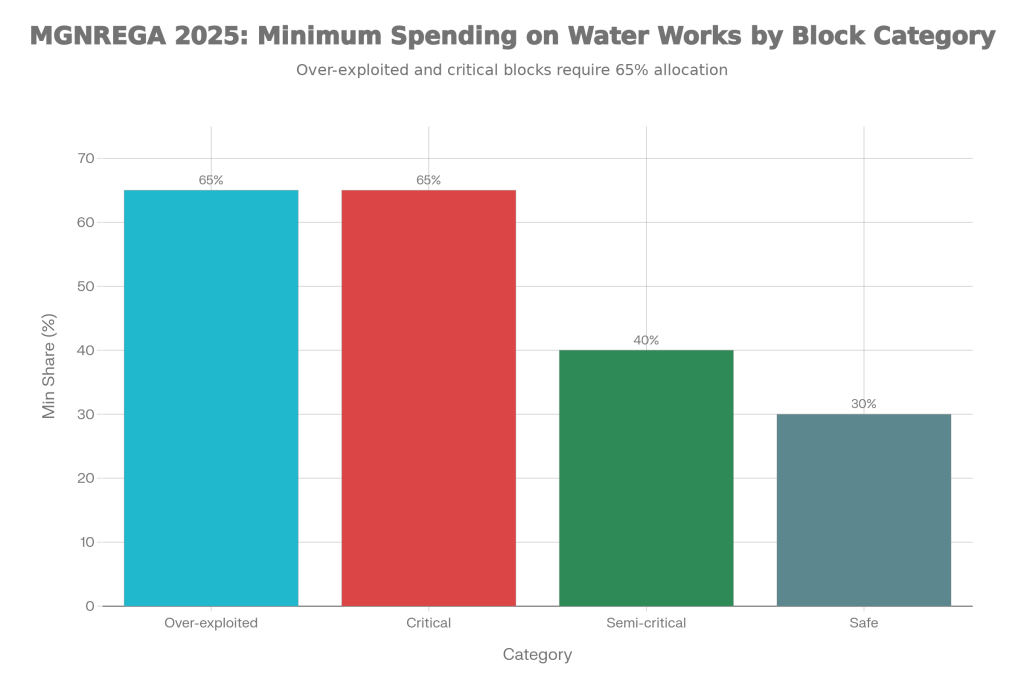
MGNREGA New Rules 2025 introduce a clear block level minimum spending rule for water conservation and water harvesting works, linked to the groundwater status of that block. In simple terms, the more stressed the groundwater situation is, the bigger the compulsory share for water works becomes. This shifts the programme from being only a jobs safety net toward being a job plus water security tool, without removing its wage employment purpose. For readers, the key point is this: planning is no longer fully flexible in water stressed blocks, because a defined portion of spending must go into water related assets.
MGNREGA New Rules 2025
| Groundwater Category Of Block | Minimum Share Of Spending On Water Related Works | What It Means For Local Planning |
|---|---|---|
| Over Exploited | 65% | Most works must focus on water conservation, harvesting, recharge, and allied water assets |
| Critical | 65% | Water works become the dominant category, similar to over exploited blocks |
| Semi Critical | 40% | A large portion is reserved for water works, while some flexibility remains |
| Safe | 30% | Even better status blocks must keep water conservation as a baseline priority |
| Total Allocation Mentioned For FY 2025 26 | Rs 86,000 crore | The overall envelope within which states plan and execute works |
| Estimated Water Works Pool Mentioned | About Rs 35,000 crore | Indicates the scale of spending likely to flow into water related works |
This is the heart of the change: the rule is not framed only at the district level; it is tied to each block’s groundwater extraction category. Once a block falls under over exploited or critical, it cannot treat water conservation as optional because at least 65% of spending must be directed toward water related works. Semi critical blocks must earmark 40%, and even safe blocks must keep 30% for water works. What this does, quietly but powerfully, is reshape the annual shelf of projects. Instead of “a few ponds if we can,” blocks now need enough technically sound water projects to meet the minimum share. Over time, this can lead to more consistent investment in recharge and storage assets, which matters because groundwater recovery is not a one season story.
What Exactly Changed In Schedule I
- Schedule I defines the types of permissible works and the planning logic of the programme. The 2025 amendment effectively inserts a compliance driven minimum requirement so that water conservation and water harvesting works must occupy a defined share of spending in each block, depending on its groundwater status.
- This matters because rules placed in the formal schedule are harder to ignore during approvals, audits, and reviews. A guideline can be treated as advisory, but a minimum spending norm creates accountability. For implementation teams, it means planning has to start earlier and be more deliberate, because you cannot meet a 65% water share without a solid pipeline of approved and ready to execute water works.
Why The Government Pushed This In 2025
- The timing makes sense if you look at what rural India has been facing: hotter summers, uneven rainfall, and rising dependence on groundwater for both drinking and farming. When wells run dry, two things happen quickly. Agriculture becomes riskier, and demand for wage work often rises because farm income becomes uncertain.
- MGNREGA New Rules 2025 try to tackle both pressures together. They keep the wage employment function intact but nudge the work portfolio toward assets that can reduce vulnerability in the next season. In other words, the policy is trying to convert part of the programme’s spending into a visible resilience dividend: better storage, better recharge, and improved soil moisture in the places that need it most.
What Counts as Water Related Works Under MGNREGA
- Many people assume “water works” means digging a pond, and that’s it. In reality, water related works can include a range of activities that either store water, slow down runoff, improve recharge, or increase soil moisture retention. The exact mix depends on local geography and technical approvals, but the typical basket includes pond renovation, desilting of traditional tanks, check dams, contour trenches, and other structures that help hold rainwater where it falls.
- The smarter approach is not to chase one type of asset everywhere, but to match the work to the problem. For example, desilting and restoring an existing community water body can deliver quick results where a water body already exists, while recharge oriented structures can be more suitable where storage is limited but infiltration is feasible. When blocks aim to comply with MGNREGA New Rules 2025, quality site selection becomes just as important as meeting the percentage.
What This Means For Gram Panchayats And Workers
- For Gram Panchayats, the rule can be a useful support. If a village has been asking for pond revival or drainage line treatment but keeps losing out to other competing works, a block level minimum makes it easier to justify water projects in the annual plan. That can reduce day to day conflicts during prioritisation because “water works first” is partly built into the rule.
- For workers, the impact is often practical. Water conservation works are labour intensive and can be scheduled in dry months, which can improve the continuity of employment in lean seasons. Over time, if water assets actually perform, they can also support agriculture, livestock, and local drinking water availability, which reduces distress migration pressure in many regions.
Which Areas May See The Biggest Shift By MGNREGA New Rules 2025
- Blocks categorised as over exploited and critical are likely to see the sharpest change in work planning because the compulsory minimum is highest at 65%. In these areas, you should expect a larger share of sanctioned works to be directly tied to water conservation and water harvesting.
- That said, the inclusion of safe blocks is also important. A 30% minimum ensures water security does not become an afterthought even in places that currently look comfortable. “Safe” status can change faster than people expect when rainfall patterns shift or extraction rises. The policy is essentially promoting prevention alongside crisis response, which is usually cheaper and more sustainable.
How States and Districts Can Implement It Well
Meeting a percentage target is easy on paper and harder on the ground. The best implementation approach is to build a strong, technically sound shelf of water works early, instead of rushing low quality works at the last moment just to hit the minimum share.
- In practical terms, good implementation usually looks like this. First, identify local water stress points and match them with feasible structures. Second, prioritise renovation of existing water bodies because rehabilitation often delivers faster results than creating new assets from scratch. Third, ensure measurement, design, and site selection are done properly so assets do not fail after one heavy monsoon.
- If this is done well, MGNREGA New Rules 2025 can improve both outcomes that the public cares about: dependable work opportunities and visible improvement in water availability. If it is done poorly, it can create a pile of rushed assets that do not hold water, which defeats the purpose.
Common Misunderstandings About The MGNREGA New Rules 2025
- One common misunderstanding is that the rule automatically increases the total budget. It does not. It reshapes how a minimum share of whatever budget is available must be spent inside each block.
- Another misunderstanding is that only one type of water work will dominate. In reality, the category should include a balanced mix of storage, recharge, and soil moisture works, depending on what the terrain needs.
- A third misunderstanding is that this change alone can “solve groundwater.” Groundwater recovery depends on cropping choices, pumping behaviour, rainfall, aquifer characteristics, and local governance. MGNREGA New Rules 2025 can support water security, but they are one lever among many. Still, they are a major lever because they influence large scale spending and local asset creation.
Labour Card New Scheme 2025 – Workers to Get Up to ₹18,000 Direct Support, Check Who Qualifies
What To Watch In 2025 And 2026
- If you want to judge whether the reform is delivering, focus on outcomes that are hard to fake. Look for revived ponds that hold water longer after the monsoon, better infiltration around recharge structures, reduced dependence on emergency water arrangements in peak summer, and more consistent work availability tied to water asset maintenance and restoration.
- Also watch for durability. A water conservation asset is only as good as its design and upkeep. The real success of MGNREGA New Rules 2025 will show up when assets survive multiple seasons, not just when they look good on a completion report.
FAQs on MGNREGA New Rules 2025
Is MNREGA New Rules 2025 Applicable Everywhere in India
Yes, the rule framework applies across blocks, but the minimum spending share differs by groundwater category. Over exploited and critical blocks have the highest minimum, while safe blocks have a lower but still meaningful minimum.
Will Water Conservation Works Reduce Unemployment
They can support employment because water works are labour intensive and can be planned during lean agricultural months. The bigger value is that these works can also strengthen local livelihoods by improving water reliability over time.
Does This Mean Non-Water Works Will Stop
No. The rule sets a minimum share for water related works. The remaining share can still fund other permissible works based on local needs, as long as the block meets the required water spending floor.
How Can Villages Ensure the Water Works Are High Quality
Villages can insist on better site selection and transparent planning in Gram Sabha meetings, and they can monitor execution closely. Strong technical design, proper measurements, and maintenance planning make a bigger difference than simply starting more works.