
Orunodoi Scheme 2025 is one of those programs people hear about from neighbors first, and then suddenly you are searching at midnight trying to find the real process, the real form, and the real eligibility rules. If you are here for Orunodoi Scheme 2025 because you want a clean, practical guide (not confusing updates), you are in the right place. The good news is that the flow is simple once you understand it: the benefit is sent through DBT to the selected beneficiary’s bank account, and the screening usually starts through local offices like GP or ULB. So instead of chasing random “instant apply” pages, it’s smarter to focus on the right form, the right documents, and the right submission channel.
Orunodoi Scheme 2025 is designed for financial support to eligible families, with a focus on women as the named beneficiary in the household. In practical terms, it means two things for you as an applicant: first, your bank details must be correct because the payment is made through DBT, and second, your local GP or ULB route matters because that is where the preliminary verification and shortlisting typically begins. If you treat it like a purely online scheme and skip local submission rules, you can waste weeks. What works best is preparing a clean application, attaching the right proofs, and submitting it correctly so the local verification team can process it smoothly.
Orunodoi Scheme 2025
Think of Orunodoi as a household support scheme that keeps women at the center of the benefit delivery. The official description highlights that the transfer is made through DBT, which is why the nominated woman’s bank account details become the backbone of the entire application. Another important point is that selection is not described as a simple first come first serve online signup, instead, the scheme process talks about local level preliminary selection and district level modalities, so local verification plays a real role.
Benefits of Orunodoi Scheme 2025
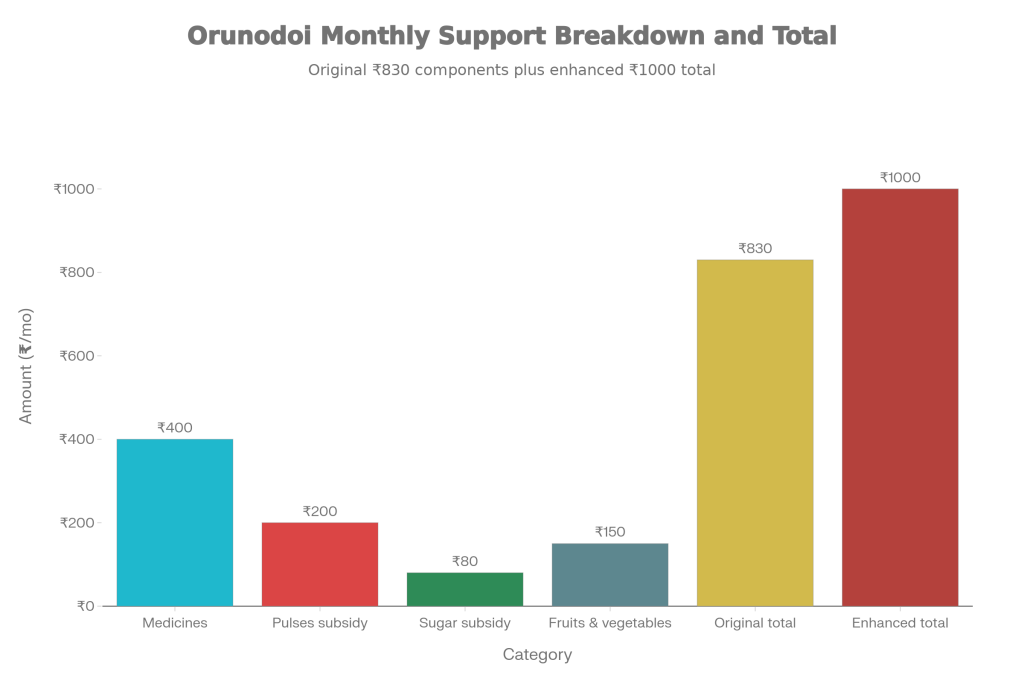
For most families, the biggest benefit is predictable monthly support that lands directly in the beneficiary’s bank account, which reduces dependency on middlemen. The official scheme page describes the benefit amount as enhanced from 830 to 1000 per woman per month, and it also explains the original intent around health and nutrition related spending. That is why, if someone is eligible, it can help cover regular household needs like basic groceries and small medical expenses without waiting for emergencies.
Here is what to keep in mind while thinking about the benefits:
- The amount is credited through DBT, so correct bank information is non negotiable.
- The beneficiary is typically the nominated woman in the family, so her name and account details should match official records.
- The scheme is not just about money, it is also about smoother delivery through verified lists prepared through local bodies.
Eligibility Criteria for Orunodoi Scheme 2025
Eligibility is where most confusion happens, because people often mix general assumptions with what the current scheme instructions actually require. The official scheme page explains that preliminary selection is carried out at GP, VCDC, or ULB level based on eligibility and ineligibility conditions, and the list is prepared through the defined process. Also, the Orunodoi 3.0 note published by the Finance Department states a basic precondition linked with NFSA enrollment for Orunodoi 3.0 beneficiaries.
To improve your chances of getting your Orunodoi Scheme 2025 application accepted at the verification stage, do these checks before submission:
- Confirm your family details are consistent across documents used locally for verification.
- Ensure the nominated woman’s bank account is active and can receive DBT credits.
- If you fall under any priority category used during local screening, keep the supporting proof ready because the form itself asks for priority supporting documents.
- If your area is currently processing Orunodoi 3.0 lists, confirm the NFSA related requirement locally because it is mentioned in the official Orunodoi 3.0 note.
How To Apply For Orunodoi Scheme 2025
Most people want a direct “apply online now” button, but the practical and safer approach is to follow the official workflow: prepare the application properly and submit it where the scheme actually accepts it for screening. The application form instruction is clear that you should take a printout and submit it to the ULB or GP office. The official scheme description also makes it clear that preliminary selection happens at GP, VCDC, or ULB level, so the local submission channel is not optional.
Here is a step by step process that works well for Orunodoi Scheme 2025 applications:
- Confirm you are following current official updates
Use official government pages and local notices to confirm if your GP or ULB is taking fresh forms or doing corrections and re verification. - Get the correct application form
Use the standard application form format used for submission, then take a clear printout. - Fill your details slowly, not in a hurry
Write your name, address, and family details neatly, because messy forms often lead to avoidable objections during checking. - Add bank details with extra care
Since the money comes through DBT, your IFSC, account number, and beneficiary name must be correct and readable. - Attach the required documents
The form specifically asks for the bank passbook front page and priority supporting documents, so do not skip attachments. - Submit the form at the right office
Submit at your GP office if you are in a rural area or the ULB office if you are in an urban area, exactly as the form instruction says. - Follow up the right way
Instead of chasing random websites, follow up through your ward member, GP office, or ULB office, because that is where preliminary lists and verification updates typically move.
Documents To Be Attached
Documentation is the part that either makes the process smooth or turns it into multiple unnecessary visits to the office. The application form itself lists key attachments, including the bank passbook front page. It also mentions priority supporting documents, which means if you are claiming any priority category considered during local screening, you should attach proof.
A simple checklist that usually keeps you safe during submission:
- Printed and filled application form with signature wherever required.
- Copy of the bank passbook front page for the nominated beneficiary.
- Priority supporting documents if applicable.
Extra practical tip: carry originals for quick cross checking at the office, but submit photocopies unless the local office specifically asks for originals.