

It Means clearly signals that the old mindset of “I have a job card, so work and wages are guaranteed” will not work in the coming years. The backbone of the system is being shifted to Aadhaar-based payments, digital attendance and smart entitlement cards such as the Ramji Card. The job card will still exist, but it will not stand alone; it has to match perfectly with your Aadhaar, bank account, mobile number and the data stored on government portals.
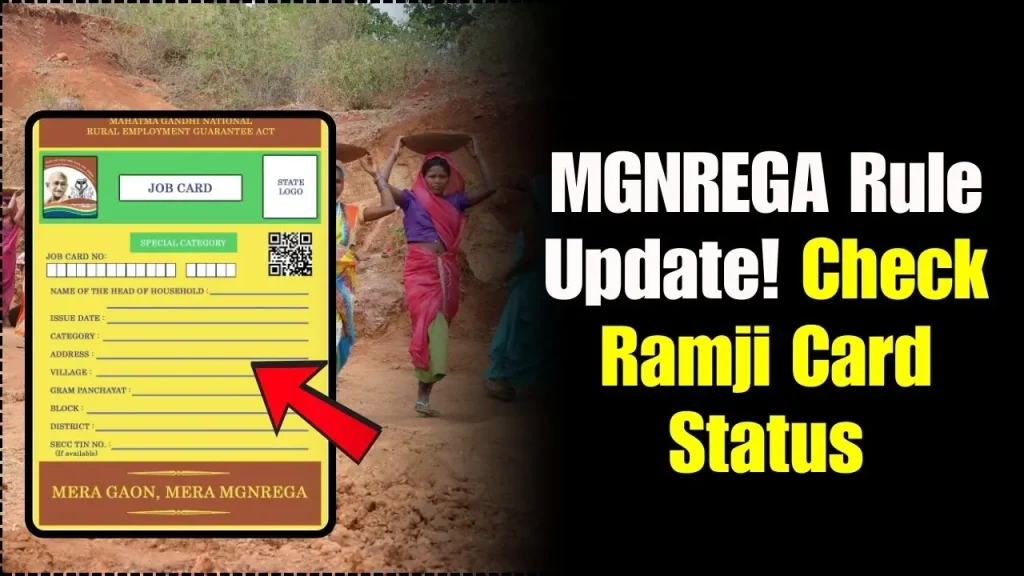
In this new setup, the government is treating rural employment as a large digital mission. The proposed framework talks about increasing the days of guaranteed work, speeding up wage payments and defining separate benefits for different categories of households. For workers, this is both an opportunity and a challenge. Those who keep their documents, linkages and cards updated on time are likely to benefit from faster, more transparent payments and clearer rights. Those who remain unaware or careless could face repeated hurdles in getting work and wages.
MGNREGA Rule Update
| Point | Brief Explanation |
|---|---|
| Scheme foundation | Legal guarantee of rural employment, shifting from classic MGNREGA to a new set-up |
| Old identification | Paper-based MGNREGA job card with about 5-year validity |
| New identification (Ramji model) | Gramin Rozgar Guarantee / Ramji Card type digital or smart entitlement card |
| Guaranteed workdays | Moving beyond earlier 100 days, towards higher assured work |
| Payment system | Aadhaar-based digital payments, direct DBT into bank accounts |
| Card validity | Valid for a limited period, with periodic verification and renewal |
| Special category cards | Separate identification for single women, elderly, disabled, special groups |
| Monitoring tools | Mobile apps, geo-tagging, biometric/digital attendance at worksites |
| Role of states | Responsible for issuing cards, verification, job demand and payment monitoring |
| Main risk for workers | Incorrect/incomplete data, poor Aadhaar–bank linking, delay in card renewal |
What Is the Ramji Card and Why Is It Becoming Crucial
You can think of the Ramji Card as the next-generation “smart job card”. The traditional job card carried only basic information: household members’ names, photographs and a few essential details. Under the Ramji Card model, the entire household profile, income category, eligibility, special status (such as woman-headed household, disabled worker, senior citizen) and work history are all captured in a digital record. Through this card, the state wants a clean and unique profile of every genuine worker and household, making fake entries much harder.
A key part of MGNREGA Rule Update: Job Card Alone Won’t Be Enough What the New Ramji Card Means is that in the future, most rights will be tied to this digital entitlement rather than just a paper card. Whether any work has been sanctioned in your name, how many days you have worked, how much wage you are owed and whether your payment has been released all of this will be mapped to that unified Ramji Card–type record. The upside is tighter control on corruption and ghost workers. The downside is that families who fail to register correctly or keep this record updated risk slipping out of the safety net.
Job Card Alone Won’t Be Enough: New Aadhaar And Digital Linking Conditions
- The era is ending where someone could confidently say, “I have a job card, so I’ll get work.” Job Card Alone Won’t Be Enough because wage payments, attendance and eligibility are all being tied to Aadhaar-based systems. If your Aadhaar number is wrong, not linked to your bank account, or not properly mapped, your wage may not get processed at all or may get stuck mid-way.
- At the same time, many states are expanding the use of biometric attendance at worksites, mobile apps for uploading geo-tagged photographs and other digital proof of work. In such a system, simply turning up with a Ramji Card or job card in hand is not sufficient. You must ensure your name appears correctly on the muster roll, that your attendance is properly captured through the app or biometric device, and that the data actually syncs with the server at the end of the day.
As MGNREGA Transforms: New Law, New Rules And Ramji Card
Another major face of MGNREGA Rule Update: Job Card Alone Won’t Be Enough What the New Ramji Card Means is the emerging legal framework. Through a new bill and related rules, the government aims to redesign large parts of the rural employment system. Provisions around total days of guaranteed work, wage payment timelines, and the responsibilities of panchayats and states are being redefined with a digital-first approach. In this model, Ramji Card–type entitlements can be tailored to different kinds of households. For example, a single woman–headed household may receive additional safeguards, a disabled worker may be promised lighter but more suitable tasks, and an elderly worker may be given special protections in both work allocation and payment timelines. On paper, all this looks like an expansion of welfare. In practice, it will only work if the digital profile of each such household is correct, active and verified on time.
What Practical Changes Will Workers Actually See
- At the ground level, the biggest change is that MGNREGA will no longer function as a simple “enter your name and work” scheme. Workers will have to manage not only physical documents but also their digital footprint. Your job card or Ramji Card, Aadhaar, bank account, mobile number and the spelling of your name and other details in the panchayat register all have to align. Only then will the entire chain from work demand to wage payment run smoothly.
- Families that adapt quickly to these changes will be in a much stronger position. They can benefit from quicker or even weekly wage payments, clearer records of work done and less scope for disputes over attendance or dues. On the other hand, households that depend only on their old job card and neglect Aadhaar linking, bank updates or card renewal may increasingly face problems like unregistered demands, no work being allotted or wages being delayed or returned.
Senior Citizens Update: 8 New Benefits and Up to ₹9,000 Support Starting January 2026
Key Preparations Workers Should Start Right Now
- Carefully match every entry on your old MGNREGA job card with your Aadhaar name, age, father/husband’s name, village name and spelling.
- Visit your bank and confirm that your Aadhaar is correctly seeded to your active account and that the account is ready for direct benefit transfer.
- Ask the panchayat when and how Ramji Card or Gramin Rozgar Guarantee Card registration will begin in your village, and what documents will be required.
- If you are a single woman, elderly, disabled or part of any special category, check whether there are separate codes or special cards for you and what additional benefits they carry.
- Keep your mobile number active and updated with the bank and panchayat records, as future SMS alerts, app-based attendance and payment messages will mostly come to your phone.
FAQs on MGNREGA Rule Update
Q1. What is the most direct impact of MGNREGA on workers?
The most direct impact is that having a job card alone will no longer guarantee work and wages. Aadhaar linking, a correctly updated bank account, Ramji Card type digital entitlements, and, in many places, mobile or biometric attendance will all become essential.
Q2. What is the main difference between the Ramji Card and the old MGNREGA job card?
The old job card was largely paper-based and mainly used to list workers and register demand for work. The Ramji Card, by contrast, is conceived as a unified digital identity and entitlement record.
Q3. If my Aadhaar is not linked to my bank account, will I still be paid when Job Card Alone Won’t Be Enough?
In a system that is moving rapidly towards Aadhaar-based payments, it is highly unlikely that you will receive wages smoothly without proper Aadhaar–bank seeding.
Q4. Will the right to compensation for delayed wage payments disappear under the new rules?
No. The legal provisions for compensation or penalty in case of delayed wage payments are expected to remain. What is changing is the effort to reduce delays through tighter weekly or faster payment schedules and better digital tracking.