
The free solar atta chakki scheme gains attention today from villages to social media because it directly touches three pain points of rural women: money, time and hard physical work. As the free solar atta chakki scheme gains attention, many women have started seeing it not just as a government initiative, but as a chance to run a small flour mill from home and build a stable income stream.
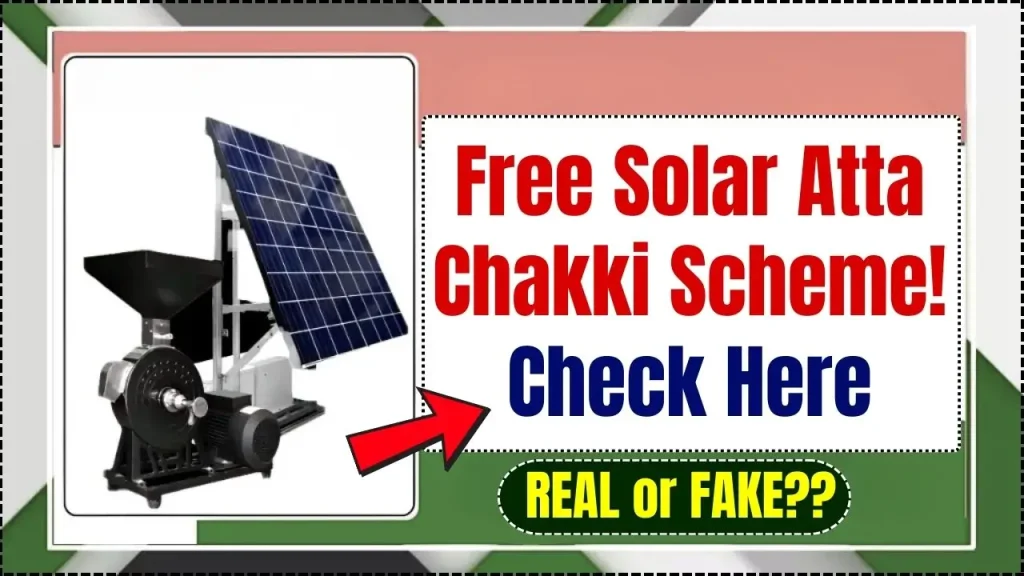
As the free solar atta chakki scheme gains attention, it is creating a visible impact on daily life in rural areas. On one side it brings down the cost and effort of flour grinding, and on the other it opens up an easy local business model for women right inside the village. Because the machine runs on solar energy, there is less dependence on regular electricity, power cuts or high bills. This keeps operating costs low and leaves more room for real profit in the hands of the woman running it.
Free Solar Atta Chakki Scheme
| Point | Details |
|---|---|
| Scheme Name | Free Solar Atta Chakki Yojana / Free Solar Flour Mill Scheme |
| Main Objective | Make rural women self-reliant and provide easy flour grinding at home and village level |
| Target Beneficiaries | Rural women, especially low-income, BPL and economically weaker groups |
| Key Benefit | Solar-powered flour mill for home use plus micro-business opportunity |
| Power Source | 100% solar energy, very low or zero electricity bill |
| Typical Support | Machine free or heavily subsidised, depending on state and scheme |
| Usage | Household flour grinding, paid grinding for neighbours, option to sell packed flour |
| Wider Impact | Extra income, time saving, green energy adoption, stronger social status for women |
| Application Mode | Through state government / department portals and offline block or district offices |
| Important Caution | Always verify details on official government portals, avoid fake links and fraud |
What is the Free Solar Atta Chakki Scheme?
At its core, this scheme focuses on providing a solar-powered flour mill that works on sunlight instead of relying fully on the conventional electricity grid. The idea is simple but powerful: rural women can grind fresh flour for their own families nearby, and at the same time turn the same machine into a small home-based business.
The setup usually includes solar panels, a motor, the flour mill unit and a basic frame or shed. It can be installed in a courtyard, verandah, anganwadi centre or a small shared space in the village. Once installed, the system can run smoothly for hours during daylight, and with a battery backup (if included) it can even be used in the evening. All of this adds up to very low running cost and long-term usability.
Why Free Solar Atta Chakki Scheme Gains Attention In 2025
In 2025, the free solar atta chakki scheme gains attention mainly because of rising prices, unstable electricity supply and a lack of decent local employment options in villages. Earlier, women often had to walk long distances or pay transport cost just to reach a flour mill in a town or market. There they waited in long queues, wasted a whole day and still had no control over timing. Now, when the same grinding facility is available inside the village or near their homes, both effort and expense come down drastically.
At the same time, national and state policies are pushing solar energy more aggressively, especially in rural areas. That means more support, awareness and interest around small solar-based units. This is why the free solar atta chakki scheme gains attention not just as a welfare idea, but as a link between renewable energy, women’s empowerment and grassroots entrepreneurship.
Key Benefits of Free Solar Atta Chakki Scheme for Rural Women
The biggest benefit of a solar atta chakki is independence and control. When a woman has her own machine, she decides when to work, how long to work and whom to serve. She no longer has to adjust to the timings and mood of a commercial mill owner. She can plan her day in her own way: household chores in the morning, grinding work in the afternoon and family time in the evening.
From an income point of view:
- She can fix her own rate per kilo, per quintal or per sack for grinding.
- During harvest season, when grain stocks are high, the demand for grinding shoots up and income also increases.
- If she wants, she can go a step further and pack flour in small branded packets and sell it through local shops, schools or small eateries.
Because the machine runs on solar energy, running cost remains very low. The more flour she grinds, the more profit she keeps, since there is no big electricity bill eating into her margin. For many women, this becomes a steady second income, and in some cases their main source of earnings.
Eligibility And Who Can Apply For Free Solar Atta Chakki Scheme
Rules can vary from state to state, but broadly the free solar atta chakki scheme is designed with rural and economically weaker women in mind. Priority usually goes to:
- Women who are permanent residents of villages or semi-rural areas.
- Families whose annual income falls below a certain limit, often within low-income or BPL category.
- Households that do not already own a commercial flour mill or similar large machine.
- Members of self-help groups (SHGs), women’s groups or farmer collectives, because they can run the unit together and share profits.
Anyone interested needs to check on their state’s official website or at district and block offices whether the scheme is actually active in their area. In many places, the free solar atta chakki scheme gains attention through news and social media first, but the real details eligibility, quota, deadlines are always found in official notifications.
Documents Required And Application Process For Free Solar Atta Chakki Scheme
Before applying, a woman generally has to keep a few basic documents ready, such as:
- Aadhaar card and ration card
- Income certificate or an accepted proof of family income
- Bank passbook copy
- Passport size photographs
- Residence proof and, if applicable, self-help group documents
The application process typically follows steps like these:
- Visit the official website of the relevant state department energy, rural development, food & civil supplies, industries etc.
- Look for the scheme name under solar atta chakki, solar flour mill or a similar heading.
- Fill the form online or download it, then carefully enter all required details.
- Upload the necessary documents online or attach photocopies if submitting offline.
- Submit the form at the designated block or district office, and keep an acknowledgement or receipt.
After verification, a beneficiary list is prepared and then distribution or subsidy release is done as per the scheme design. Here again, while the free solar atta chakki scheme gains attention across platforms, the safest way is to follow only the process mentioned in government notifications, not in random videos or posts.
Real Impact of Solar Atta Chakki’s in Villages
Wherever solar atta chakkis have reached, the impact is visible in both financial and social terms. Many women who earlier stayed limited to unpaid domestic work are now earning real money and directly contributing to family expenses like children’s education, healthcare or loan repayment. This shifts how the family and the village look at them – from “dependent” to “earning member.”
Farmers benefit as well. During harvest season, when there is a rush to grind wheat, maize, millets or pulses, existing mills often fail to handle the load on time. A local solar flour mill inside the village reduces delays and transport cost. People can get their grain ground as per their convenience, without worrying about power cuts or mill closing hours. The result is smoother post-harvest handling and less wastage.
Why Free Solar Atta Chakki Scheme Gains Attention On Social Media
On social media and YouTube, the free solar atta chakki scheme gains attention because women themselves are sharing their stories. One talks about paying school fees from her grinding income; another about no longer standing in line for hours at a town mill. These real-life stories build trust and inspire other women to apply or at least explore the option.
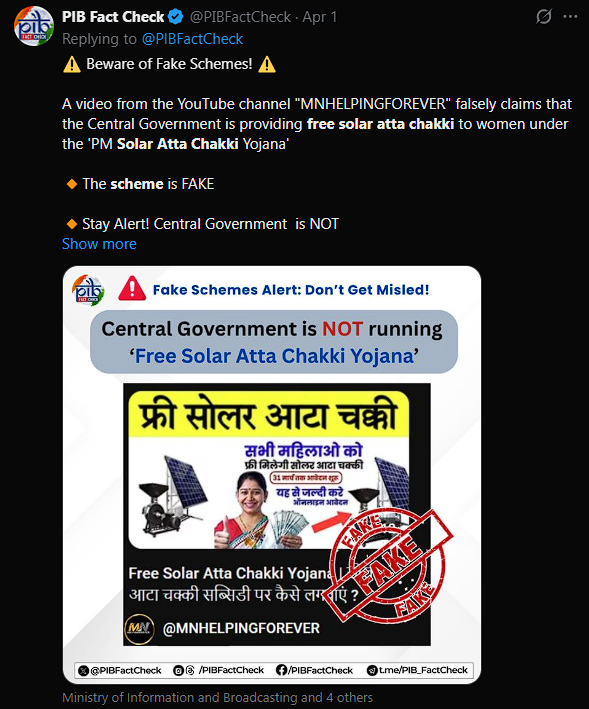
However, the same visibility also attracts misleading or exaggerated content. Some creators advertise it as if “every woman will get a free machine with no conditions,” which is rarely true. In reality, each scheme has limits, quotas and rules. That is why it is important to treat social media as an initial source of awareness only, and always cross-check details with official documents before taking any financial or legal step.
Stay Alert and Avoid Fake Offers
Because the free solar atta chakki scheme gains attention so fast, fraud attempts naturally grow around it. Some people ask for “registration fees,” “processing charges” or “lottery deposits” to get your name into a supposed list. Many of these demands are not backed by any official order.
To stay safe:
- Trust only official government websites, district notice boards and verified help centres.
- Never share bank details, OTPs or UPI payments with unknown callers or links.
- Do not pay any money without a proper receipt from a recognised office.
- If in doubt, visit your block or panchayat office and ask directly about the scheme.
A little caution ensures that you enjoy the real benefits of the scheme without falling into traps.
EPFO Pension Update 2025: 2 New Rules + 5 Major Benefits Announced — Big Changes Ahead
How Rural Women Can Get The Most Benefit
The scheme gives its best results when the solar atta chakki is treated as a micro-enterprise, not just a household gadget. Women can:
- Fix specific working hours so that villagers know when they can come for grinding.
- Clearly display their rates on a board near the machine.
- Tie up with local shops, schools, anganwadis or small eateries that need regular flour or pulses.
- Keep records of daily grinding to track income and growth.
Used smartly, the free solar atta chakki scheme gains attention not only as an “aid” but as a steppingstone into entrepreneurship. Women who once worried only about managing expenses can now think about expanding, upgrading or even hiring help in the long run.
FAQs on Free Solar Atta Chakki Scheme
Is the free solar atta chakki scheme active in every state?
No, the scheme is not identical or active in the same way across all states. In some places it may be fully launched, in others it may be limited to selected districts or still at proposal or pilot stage.
Is the solar atta chakki completely free?
In many promotions it is described as “free,” but in reality, some schemes offer full subsidy, some only partial support and some combine subsidy with low-interest loans.
How much income can a woman earn from one solar atta chakki?
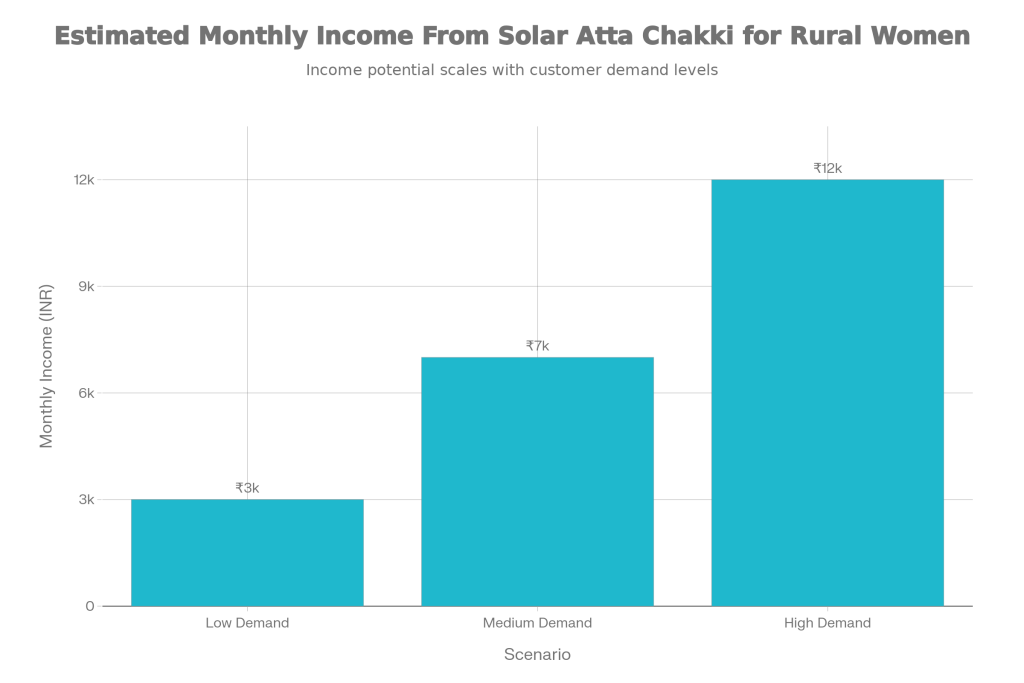
Income depends on how much grain is ground daily and what rate she charges. In smaller villages with less competition, a woman can often earn a few thousand rupees a month as extra income, and in busy areas with high demand, the amount can be significantly higher.
What is the safest way to apply for the scheme?
The safest way is to use only official channels. Fill forms through recognised government websites or collect them from block, tehsil or district offices.