

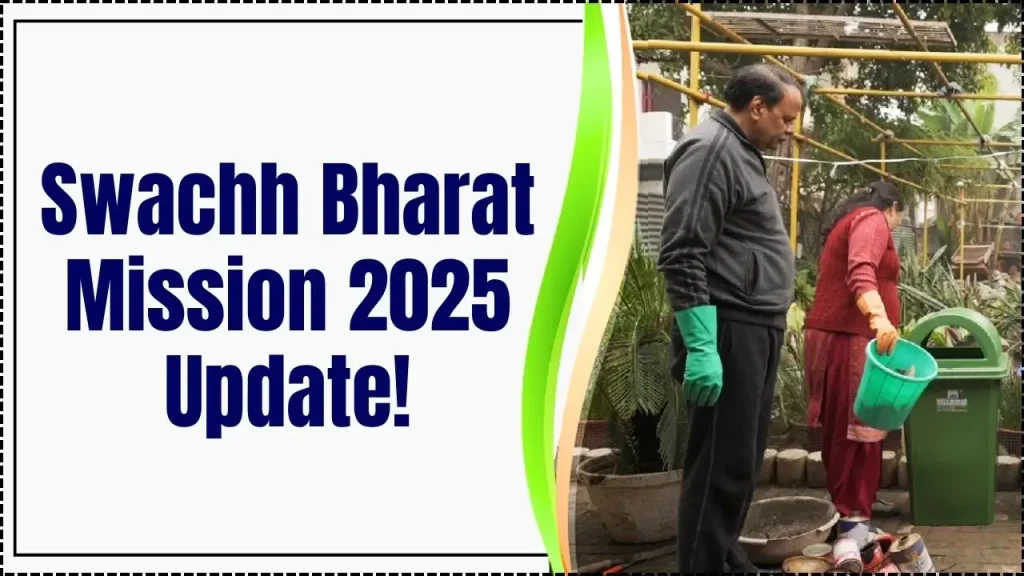
Swachh Bharat Mission 2025 update marks the shift from a construction-driven campaign to a system-driven mission. The rural programme, SBM-Grameen Phase II, is designed to run from 2020–21 to 2025–26, with a very clear priority: sustain ODF and build strong solid and liquid waste management (SLWM) systems in every village. The idea is simple but demanding toilets must be used, the surroundings must stay clean, and waste should not simply move from inside the house to the roadside.
Parallel to this, Swachh Bharat Mission Urban 2.0 is pushing cities towards “garbage-free” status. Instead of counting toilets alone, urban performance is evaluated through Swachh Survekshan surveys, where every city is scored on door-to-door waste collection, segregation, processing capacity, public toilet availability, user feedback and visible cleanliness. The 2025 framework is tighter, more data-driven and more competitive than earlier rounds, which is why cities and states are feeling the heat.
Swachh Bharat Mission 2025
| Indicator | Latest Update / Highlight |
|---|---|
| Rural ODF Status | All States and UTs declared ODF in the first phase; current focus is on sustaining behaviour and preventing slippage. |
| ODF Plus Villages (2025) | Well over five and a half lakh villages have been declared ODF Plus out of a total of around 5.8–5.9 lakh villages. |
| ODF Plus Categories | Villages are graded as Aspiring, Rising or Model based on solid and liquid waste management and asset upkeep. |
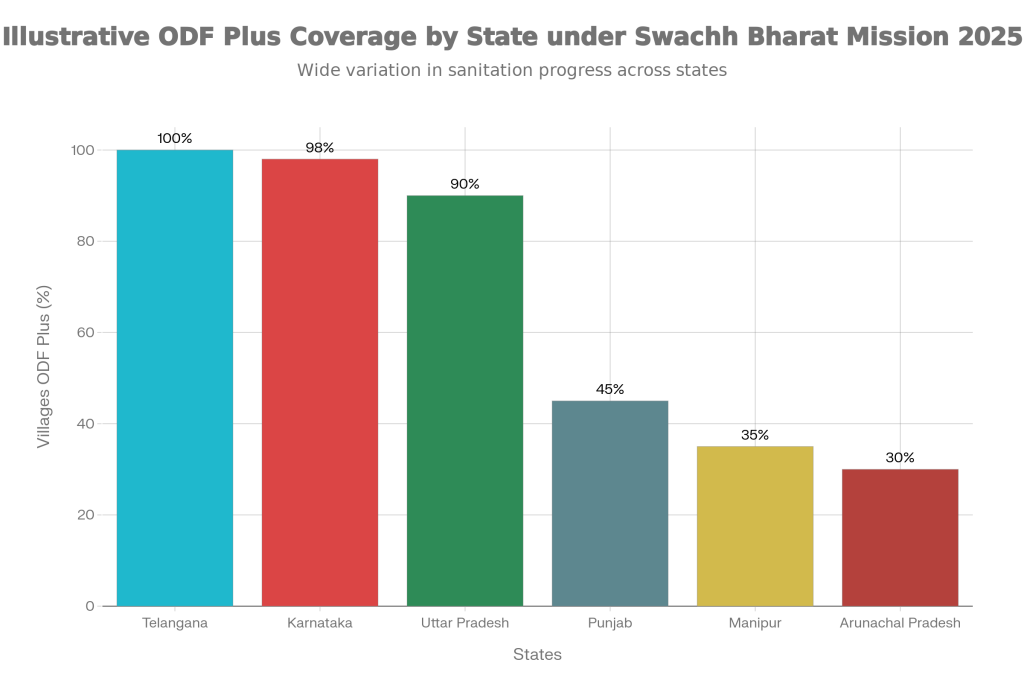
| Top ODF Plus Performers (Rural) | Telangana, Karnataka and Uttar Pradesh stand out with very high shares of ODF Plus villages. |
| Low ODF Plus Performers (Rural) | Manipur, Arunachal Pradesh and Punjab show relatively low ODF Plus coverage compared to their total villages. |
| Mission Period (Rural Phase II) | SBM-Grameen Phase II spans 2020–21 to 2025–26 with a strong emphasis on ODF sustainability and waste systems. |
| Urban Cleanliness Rankings | Swachh Survekshan 2024–25 places cities like Indore, Surat and Navi Mumbai at the top of national cleanliness charts. |
| Urban Mission Goal | SBM-Urban 2.0 aims for garbage-free cities, 100% scientific waste processing and remediation of legacy dumpsites. |
ODF And ODF Plus – Where India Stands
On paper, the country’s big ODF declaration milestone was reached a few years ago. Toilets were built at scale, and almost all rural households were officially covered. But the real story only started after those announcements. Open defecation does not end forever with the construction of a toilet; it ends when that toilet is consistently used, maintained and supported by water supply and cleanliness.
This is where ODF Plus comes in, and it dominates the Swachh Bharat Mission 2025 update. An ODF Plus village is not just one where open defecation has stopped, but also one where solid waste, liquid waste and community sanitation assets are properly managed. By 2025, the vast majority of Indian villages fall under the ODF Plus umbrella, but they are not all at the same level. Some are just beginning the journey (Aspiring), some are progressing (Rising), and some have really robust waste management systems (Model). That tiered approach makes it easy to see which areas simply cleared the first bar and which ones are pushing towards lasting cleanliness.
CSC Numbers and Rural Sanitation Infrastructure
Community Sanitary Complexes (CSCs) are a quiet but powerful part of the Swachh Bharat Mission 2025 update. These are the facilities that serve people who may not have access to individual household toilets landless families, daily wage labourers, migrant workers, visitors and especially women and the elderly in such groups. In the earlier phase, the focus was mainly on building these complexes. Now, the question has shifted to: are they clean, are they safe, and are they usable at all hours?
Under SBM-Grameen Phase II, funding is available not just for putting up new CSCs but also for renovating, retrofitting and ensuring basics like water connection, separate sections for men and women, ramps, and proper lighting. Many high-performing states have integrated CSC management into panchayat-level planning and handed over daily operations to local user groups or self-help groups. Along with CSCs, investments in soak pits, drainage lines, greywater channels, compost pits and small solid waste collection centres are turning sanitation into a full system rather than a single structure.
Best Performing States Under Swachh Bharat Mission 2025
When you dig into Swachh Bharat Mission 2025 update data state by state, some names consistently appear at the top. Telangana is often cited as a front-runner, having declared all its villages ODF Plus with a growing share moving into the higher-quality categories. This outcome is closely tied to steady political backing, regular monitoring and tight coordination between district administrations and gram panchayats.
Karnataka is another strong performer, with almost all villages under ODF Plus and an aggressive push on solid waste management units, plastic collection and greywater treatment. Uttar Pradesh is perhaps the most interesting case: a state with massive population and complex challenges, yet now showing impressive progress in the absolute number of ODF Plus villages. These best-performing states prove that scale and diversity do not have to be barriers when the mission is treated as a core governance priority rather than just a campaign.
Worst Performing States and the Gaps That Remain
On the flip side, Swachh Bharat Mission 2025 update also sheds light on states that have struggled to convert ODF gains into ODF Plus reality. Some of the weakest numbers come from the North-Eastern region and a few comparatively prosperous states that might not have expected to be at the bottom. Manipur has only a small share of villages that have managed to secure ODF Plus status, signalling difficulties in follow-up, monitoring and building SLWM infrastructure across scattered and sometimes conflict-affected regions.
Arunachal Pradesh faces its own combination of geographical isolation, tough terrain and limited institutional capacity, which makes setting up and running waste systems in remote villages a complex task. Punjab, meanwhile, shows that economic strength alone does not guarantee sanitation success. Despite better average incomes, the state’s share of ODF Plus villages is relatively low, suggesting that sanitation has not been treated as an equal priority compared to other development issues. These weaker performers remind us that Swachh Bharat Mission 2025 update is also about political will, local engagement and administrative stamina.
Urban Rankings – Cleanest and Dirtiest Cities
Urban India adds another layer to the narrative. Swachh Survekshan 2024–25, the country’s flagship cleanliness survey, directly feeds into the Swachh Bharat Mission 2025 update by ranking cities and rewarding or penalising them through public recognition and, in some cases, funding and technical support. Once again, cities like Indore, Surat and Navi Mumbai sit at the top. Their formula is fairly clear: 100% door-to-door collection, high levels of segregation at source, strong processing capacity, decentralised composting and biogas units, and near-constant citizen engagement.
But rankings also expose a list of cities that are still struggling with basic services. These places typically have open waste dumping, poorly maintained public toilets, weak grievance redressal and low levels of citizen trust. The gap between top and bottom cities is not just about money; it is about systems, leadership and how seriously municipal bodies treat feedback from residents. By linking awards, scores and national visibility to performance, the urban component of Swachh Bharat Mission 2025 update puts real pressure on city administrations to improve or risk public criticism.
Ration Card Update: Free LPG Cylinder + ₹1,000 Support Now Available for Eligible Families
What Swachh Bharat Mission 2025 Means for Citizens
Beyond the dashboards and rankings, Swachh Bharat Mission 2025 update is really about how daily life feels for ordinary people. For a rural family, it can mean having a nearby CSC that is clean, safe and lit at night, or seeing that the drain outside their home is covered and not stagnating. For an urban resident, it could mean that the street is swept regularly, waste is picked up on time, public toilets are usable and neighbourhood parks are free from garbage.
The mission is also slowly changing how communities view waste. Segregation at source, once seen as an extra burden, is becoming more mainstream, especially where local authorities have backed it up with regular collection and clear communication. Youth groups, self-help groups and school children are being involved in monitoring and awareness campaigns, turning sanitation into a shared responsibility. In that sense, Swachh Bharat Bharat Mission 2025 update is a reminder that lasting cleanliness is not just built with government money; it is co-created by citizens every day.
FAQs on Swachh Bharat Mission 2025
1. What is the main focus of Swachh Bharat Mission 2025 update?
The central focus in 2025 is on sustaining the ODF status achieved earlier and upgrading villages and cities to ODF Plus and garbage-free levels.
2. What does ODF Plus actually mean for a village?
ODF Plus means a village has not only stopped open defecation but also built systems for managing household and community waste.
3. How important are CSC numbers in the current phase?
Community Sanitary Complexes are extremely important in Swachh Bharat Mission 2025 update because they serve people who cannot easily build or use private toilets.
4. Which states are considered best and worst performers right now?
States like Telangana, Karnataka and Uttar Pradesh are counted among the best performers due to their very high coverage of ODF Plus villages and stronger waste systems.