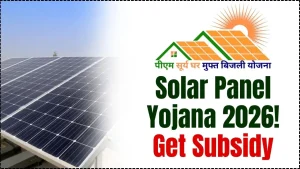

Families across India are finally seeing a clear path to lighter electricity bills thanks to the 300 units free electricity scheme—delivered nationally through PM Surya Ghar: Muft Bijli Yojana and reinforced in some states through direct bill relief. If you’re a homeowner or tenant with a usable rooftop, this is the simplest opportunity in years to cut monthly costs, stabilize your budget, and future-proof your home energy. The promise is straightforward: size a rooftop solar system to your usage, connect through net metering, and offset up to 300 units a month so most routine bills drop close to zero in sunny periods.
The 300 units free electricity scheme works in two complementary ways: nationally, through solar generation credits that cancel a large portion of your consumption; and in select states, via blanket free-unit slabs credited directly on domestic bills. This dual path means you can either start saving immediately where state relief applies, or lock in ongoing savings by generating your own power at home often the smarter long-term play. In practical terms, the 300 Units Free Electricity Scheme helps a typical low-to-mid consumption home reach near-zero bills by installing a 2–3 kW rooftop solar system, linking it to the grid with net metering, and letting daytime production offset monthly consumption; where states add direct bill waivers, the relief compounds further for households within the slab.
300 Units Free Electricity Scheme
| Key Item | Details |
|---|---|
| National Program | PM Surya Ghar: Muft Bijli Yojana enables up to 300 units/month free via rooftop solar generation and net metering for residential consumers. |
| Subsidy Benchmark | Approx. ₹30,000 (1 kW), ₹60,000 (2 kW), ₹78,000 (3 kW+); credited post-installation verification under notified guidelines. |
| Target Reach | One crore households, standardized via a central portal, vendor empanelment, and net metering workflow. |
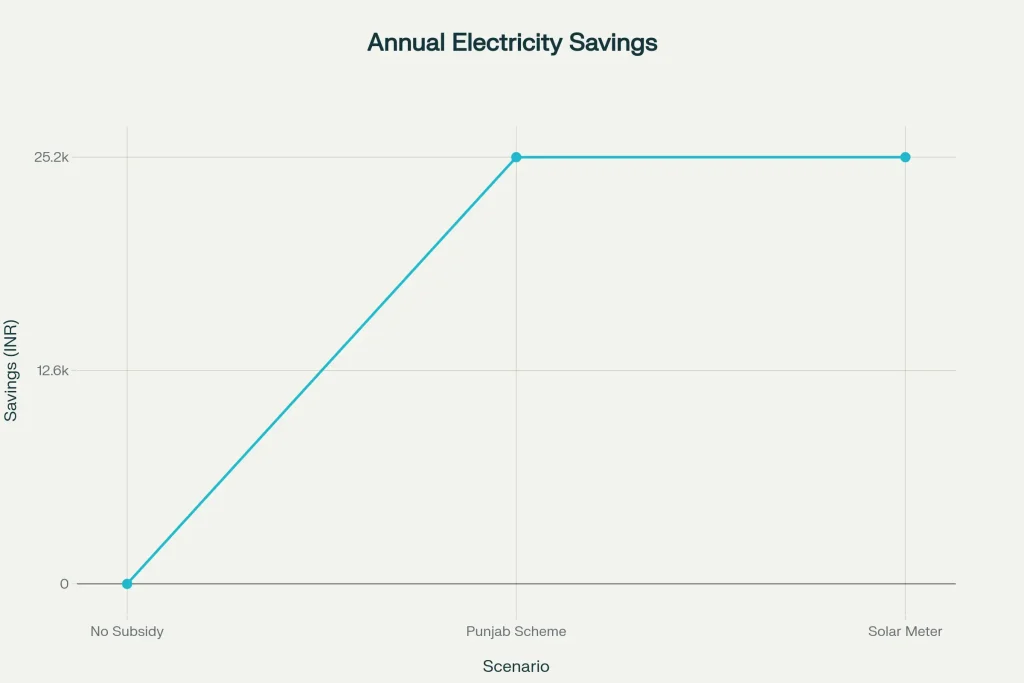
| State Example | Punjab provides 300 units/month free in a 600-unit bimonthly cycle for domestic consumers. |
| Typical Sizing | 2–3 kW rooftop systems commonly suit homes using 150–300 units/month. |
| Process Flow | Register on the national portal, secure feasibility approval, install via empanelled vendor, integrate net meter, receive subsidy and unit credits. |
Pm Surya Ghar: Muft Bijli Yojana
This central scheme is the backbone of the nationwide 300 units free electricity scheme, designed to make rooftop solar affordable, standardized, and quick to deploy. Consumers register online, choose their DISCOM and state, pick an empanelled vendor, get a feasibility nod, and proceed to installation and net metering. The one-time subsidy (credited to your bank post-verification) lowers upfront cost, while monthly generation credits reduce or eliminate bills especially for homes sized near the 300-unit band. A 3 kW system in favorable conditions can produce more than 300 units in a month, aligning neatly with the scheme’s goal. The result is a stable, predictable reduction in household expenses and a tangible step toward energy independence.
Who Can Benefit from 300 Units Free Electricity Scheme
- Homeowners with suitable rooftops who want predictable, lower power bills.
- Tenants in independent houses where landlords support rooftop installations and contract updates.
- Households in states offering blanket free slabs (e.g., 300 units/month) that further compress costs for low-to-mid usage.
- Families planning future loads like inverter refrigerators, extra fans, or an EV who want a system sized for tomorrow, not just today.
Eligibility And Documents Required for 300 Units Free Electricity Scheme
- Residential consumer with an active electricity connection.
- Usable rooftop with adequate sunlight and structural suitability.
- No overlapping subsidy already claimed for the same connection or system.
- Standard KYC, recent electricity bill, bank details for subsidy transfer, and property ownership or permission documents.
Step-By-Step Application Process for 300 Units Free Electricity Scheme
- Register on the official national portal by selecting your state and DISCOM and verifying your consumer details.
- Choose an empanelled vendor and finalize the provisional system size based on your monthly units.
- Obtain DISCOM feasibility approval before any installation work.
- Install the rooftop solar system, complete inspections, and get the net meter integrated.
- Submit commissioning documents to receive the subsidy and start seeing monthly credits on your bill.
What 300 Units Really Means
For many Indian households, 300 units is the sweet spot covering fans, lights, a fridge, washing, and a handful of appliances without aggressive power cuts to lifestyle. When your 2–3 kW system aligns with your typical usage, daytime solar serves your load first and exports any surplus to the grid; net metering then offsets imports later, reducing the net payable. In sunny months, bills can approach zero except nominal charges like meter rent; in monsoon or winter dips, the bill remains materially lower than pre-solar levels.
State Relief: Punjab As a Model
Punjab’s 300 units per month free (600 units per bimonthly cycle) demonstrates how blanket relief can deliver immediate savings for domestic consumers. If you stay within the cycle cap, bills drop sharply; if you exceed it, special provisions apply for priority categories, while general consumers pay as per notified rules. Where such state waivers coexist with rooftop solar, households can double down: solar offsets a chunk of consumption, while the free slab cleans up the rest especially powerful for moderate users.
Smart System Sizing
- Map your average monthly units over the past 12 months; identify peak and off-peak seasons.
- For 150–300 units/month, consider a 2–3 kW system; where roofs are shaded or small, focus on high-efficiency modules.
- Plan for future loads (e.g., room air-coolers, induction cooking, small EV) so you don’t outgrow the system within a year.
- Ensure proper tilt, shade analysis, and inverter capacity; a clean design beats an oversized, underperforming array.
Cost, Subsidy, And Payback
Upfront cost varies by region, component quality, and installation complexity; the one-time central subsidy meaningfully reduces the net outlay. With bills trimmed every month often by the bulk of your consumption payback periods can be attractive, especially when electricity tariffs rise. Over the system’s life, total savings typically exceed the initial cost by a wide margin, even accounting for minor O&M and periodic cleaning.
Net Metering and Billing
Net metering tracks import and export to the grid. Daytime generation first powers your home; surplus flows out and earns credits, while nighttime or cloudy-day imports are offset by those credits. Your bill reflects the net position for the cycle and any fixed or service charges. Once the meter is live, monitor usage through your DISCOM app or meter interface and review monthly statements to verify credits are applying correctly.
Installation And Vendor Checklist
- Use only empanelled vendors and MNRE-compliant equipment so your subsidy and net metering remain valid.
- Confirm structure load, mounting quality, wind considerations, cabling, earthing, and surge protection.
- Demand a proper commissioning report, single-line diagram, and inverter settings log.
- Set up remote monitoring for the inverter if available; it helps track daily generation and flag issues early.
- Schedule periodic cleaning to maintain output; dust and bird droppings can significantly undercut generation.
Maintenance And Warranty
Quality modules often carry 10–12 years product warranty and 25-year performance warranties, while inverters typically carry 5–10 years depending on brand. Keep records handy, ensure proper ventilation for inverters, and follow the O&M manual. Simple practices like quarterly cleaning and annual electrical checks protect generation and system life.
Common Pitfalls To Avoid
- Skipping feasibility checks or installing before approvals leads to delays or ineligibility for subsidy.
- Choosing non-empanelled vendors jeopardizes both subsidy and net metering.
- Ignoring shade analysis or using mismatched components curtails output, making it harder to hit 300 units.
- Oversizing without structural assessment risks roof damage and compliance issues.
Viksit Bharat Rozgar Scheme 2025: How the New Initiative Aims to Create More Jobs
Action Plan For Households
- Audit 12 months of bills to find your true monthly average.
- Shortlist 2–3 empanelled vendors; compare proposals on module efficiency, inverter brand, warranties, and total cost.
- Align system size with your 300 units free electricity scheme goal to minimize net payable amounts.
- Track your application milestones: registration, feasibility, installation, net meter, commissioning, subsidy credit.
- Monitor monthly bills and generation to validate savings and adjust consumption if needed.
The 300 units free electricity scheme gives households two clear routes to real savings: generate your own power through PM Surya Ghar and offset up to 300 units via net metering or tap state-level free slabs where available for immediate relief. Size the system wisely, follow the approved process, and keep an eye on bills and generation and you’ll see the monthly burden fall, while your home becomes cleaner, more resilient, and ready for the future.
FAQs on 300 Units Free Electricity Scheme
How do I get 300 units free each month?
Install a rooftop solar system under the national framework, complete net metering, and size it to roughly match your monthly consumption so generation credits offset up to 300 units.
Can I get the benefit without solar?
In some states offering blanket relief (like 300 units/month free on domestic connections), you’ll see direct bill savings even without installing solar.
How much subsidy is available for 3 kW?
Benchmark central support commonly cited for 3 kW systems is around ₹78,000, credited to your bank account after successful commissioning and verification.
What if I exceed the free slab in a state scheme?
General consumers usually pay as per notified rules for the cycle if they cross the cap, while priority categories may get special treatment based on state circulars.