

The idea of $2000 for every American has roared back into the headlines, and this time there’s a clearer hint about timing. The latest signals point to a mid-2026 window as the earliest realistic launch for what’s being branded as a “tariff dividend,” not a traditional stimulus check. That matters for expectations: there’s no credible pathway for 2025, and any payout will depend on Congress, the courts, and whether the arithmetic of tariff revenue can carry the weight of $2000 for every American. For now, treat it as a serious proposal with political momentum yet still a proposal with big moving parts.

This is the focus keyword readers are asking about, and the short answer is this: $2000 for every American is framed as a dividend backed by tariff revenue, with mid-2026 emerging as the earliest target if lawmakers pass a bill and agencies can stand up the delivery mechanism in time. Practically, don’t expect holiday checks in 2025. Expect a design that targets low- and middle-income households, possibly excludes high earners, and could arrive either as direct payments or as a refundable tax credit if that proves faster to deploy at scale. In other words, watch the bill text and implementation notes more than the slogans.
$2000 for Every American
| Key Point | What’s Known |
|---|---|
| Earliest timing | Mid-2026 appears most realistic; 2025 is off the table |
| Amount | Proposed $2000 “tariff dividend” per eligible person, not guaranteed universal |
| Eligibility | Likely targeted to low- and middle-income households; high earners excluded |
| Mechanism | Direct checks or refundable tax credit are both in play |
| Legislative path | Requires congressional approval before any money goes out |
| Political climate | Republican skepticism could delay, dilute, or reshape the plan |
| Funding math | Universal $2000 would strain tariff revenue; potential budget gap |
| Legal context | Supreme Court review of tariff authority could shift the outlook |
$2000 for every American now has a timeline anchor: mid-2026, contingent on legislation, administrative readiness, and the legal footing of tariff revenue. The headline may suggest universality, but the likely reality is targeted eligibility, a potential pivot to refundable credits, and careful sequencing to match costs with receipts. If you’re budgeting, plan conservatively: watch for bill text, keep tax records current, and treat any date before mid-2026 as unrealistic. Above all, remember that $2000 for every American is still a policy proposal one that can evolve significantly between press-friendly promises and the statutory fine print.
What Trump Actually Said
The most concrete new information is timing: “middle of next year, a little bit later than that,” interpreted in context as mid-2026, not 2025. That’s not a casual estimate; it reflects the realities of drafting, passing, and implementing a law with nationwide payment consequences. The branding matters too. Calling it a “tariff dividend” signals two things at once: first, a promise that trade revenue not income taxes will finance it; second, a justification for narrowly targeting the money to households that feel inflation and import costs most acutely. That targeting would also help stretch limited tariff receipts further than a universal payout.
Who Would Qualify for $2000 for Every American
While final rules hinge on legislation, public statements point to a preference for low- and middle-income households with high earners excluded. That could mean income thresholds similar to pandemic-era checks or a fresh set of cutoffs aligned with tax filing data. Two open questions could materially change impact: whether dependents are included and at what amount, and whether phaseouts mirror earlier stimulus structures. If dependents qualify, costs rise significantly; expect lawmakers to weigh that against tariff intake and deficit targets. The cleanest path to speed and accuracy would use IRS income data to qualify recipients and rely on direct deposit where possible.
When Checks Could Realistically Arrive
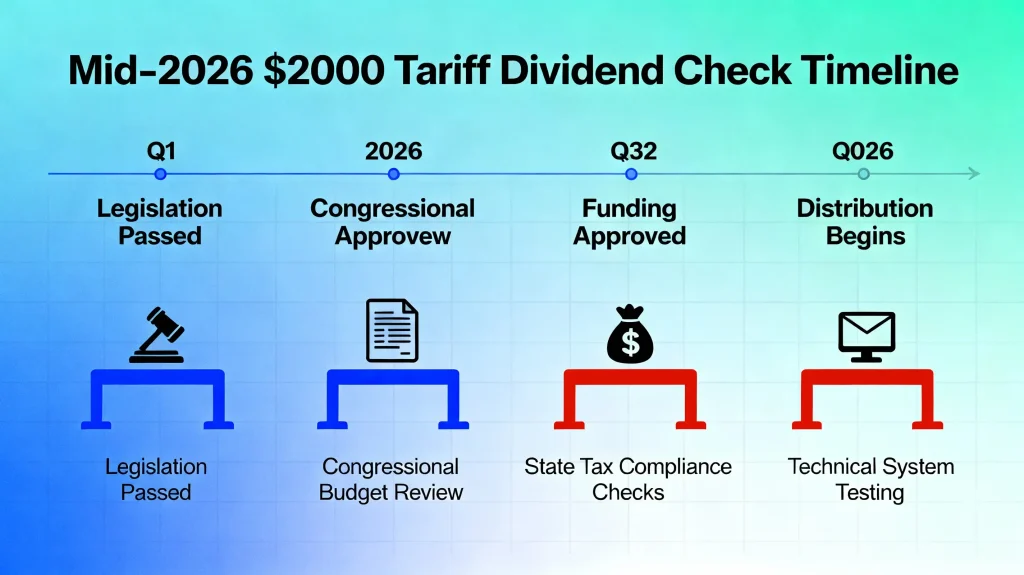
Even in a best-case scenario, $2000 for every American won’t materialize in 2025. The likely sequence runs like this: Congress passes a bill in late 2025 or early 2026; Treasury and the IRS finalize eligibility, verification, and distribution logistics; payments or credits roll out 8–12 weeks later. That calendar aligns expectations around mid-2026 for the first wave. If lawmakers opt for a refundable tax credit configured to the 2026 filing season, the benefit could arrive through tax refunds rather than separately branded checks. That approach trades splash for speed and administrative simplicity.
Why Legislation Is the Choke Point
No matter how it’s framed, $2000 for every American requires statutory authority. That’s not a technicality—it’s the whole ballgame. Congress must define eligibility, the payment mechanism (check, deposit, rebate, or credit), the funding source, and the oversight guardrails. The more universal the promise, the heavier the price tag and the steeper the political climb. The more targeted the design, the easier it becomes to align cost with projected tariff receipts and to address deficit concerns. Don’t underestimate the drafting work: precise definitions around income, filing status, dependents, and identity verification will determine both fairness and fraud risk.
The Funding Math Problem
This is the hard part. A universal $2000 for every American implies a cost that can push into the mid-hundreds of billions if dependents are included even for a single round. Tariff revenue, even under aggressive projections, may not fully cover that scale without either cutting the benefit, narrowing eligibility, spacing payments out over time, or backstopping with borrowing. Policymakers weighing $2000 for every American will therefore face a menu of trade-offs:
- Reduce the amount per person to match tariff inflows.
- Target payments to lower-income thresholds to curb cost.
- Pay less to dependents, or exclude them.
- Deliver the benefit every other year or tie it to actual tariff collections.
- Shift from checks to a tax credit to smooth cash flow and verification.
Why Republicans Are Split
On paper, $2000 for every American is popular. In practice, deficit hawks balk at the outlays, and inflation watchers worry about demand-side heat if the economy is already running warm. Others see political upside, especially if the benefit is narrowly targeted and pitched as giving back tariff proceeds to households hurt by higher import prices. That split creates a negotiation stage where the proposal can morph: amounts tweaked, eligibility tightened, and delivery mechanisms altered to reduce sticker shock. The net result may still look like $2000 for every American in headline form, but the fine print could tell a different story.
Legal Wild Card: Tariff Authority
Another open front sits in the courts. If key tariffs underpinning the “dividend” are curtailed or struck down, projected revenue could fall, or prior collections might be subject to refunds to importers. That risk doesn’t kill $2000 for every American outright, but it complicates the funding narrative and might force lawmakers to rely on general revenues or redesigned trade measures. Expect any bill to include contingency language either scaling payments to verified inflows or authorizing Treasury to adjust disbursements if legal outcomes change the base.
How To Prepare If You Might Qualify
- Ensure tax filings are up to date, including direct deposit info with the IRS, to speed any distribution.
- Keep documentation for dependents current; eligibility may hinge on the most recent filed year.
- If a credit format emerges, adjust withholding or estimated payments carefully to avoid cash flow surprises at filing time.
- Avoid scams: no official will ask for payment to release $2000 for every American, and applications are not required unless stated in law.
What Could Delay It
Three bottlenecks can push timing rightward:
- Legislative gridlock: Disagreements on amount, eligibility, and deficit impact can slow passage.
- Administrative setup: Identity verification, fraud controls, and payment rails require testing and inter-agency coordination.
- Legal uncertainty: Court rulings on tariff authority could shift the funding base or require redesign.
Why The “Dividend” Branding Matters
Labeling the plan a dividend signals a policy philosophy: taxpayers, not the federal balance sheet, are the intended beneficiaries of tariff proceeds. It also primes the public for income targeting, since dividends in capital markets are often governed by qualification dates and rules. In practice, the dividend label does not change the need for Congress to authorize payments nor the necessity of reconciling cost with revenue.
Scenario Planning: How It Might Actually Roll Out
- Targeted Checks, Single Round: $2000 to individuals under a set income threshold, with scaled amounts for dependents. Direct deposit prioritized; paper checks as fallback.
- Refundable Credit: A $2000 line-item credit in the 2026 filing season for eligible taxpayers, advancing some payments to verified bank accounts.
- Phased Payments: Two $1000 tranches tied to revenue milestones, reducing deficit impact and smoothing logistics.
- Every-Other-Year Dividend: Payments aligned to realized tariff receipts, designed to be revenue neutral over two-year cycles.
$2000 For Every American and Inflation
Macroeconomic effects depend on how targeted and how fast the money hits. A tightly targeted credit to lower-income households has a higher propensity to be spent quickly, which can support consumption but also add price pressure if supply is tight. A phased or credit-based design can temper that impulse, especially if paired with deficit offsets elsewhere or scheduled against actual tariff inflows. Expect economists to scrutinize these dials in committee hearings.
Political Optics and Timing
Mid-2026 delivery sits in a politically sensitive window. That can cut both ways: supporters will argue it’s timely relief tied to a campaign promise; critics will call it calendar engineering. Either way, $2000 for every American will live in a contested space where policy substance and election narratives collide. That reality often pushes compromises that are less splashy but more durable.
FAQs on $2000 for Every American
Is this the same as a stimulus check?
Not exactly. It’s positioned as a “tariff dividend,” but if Congress authorizes checks or a refundable credit, the end result could look similar in practice.
Will everyone get $2000?
Unlikely. The strongest signals point to excluding high earners and prioritizing low- and middle-income households; dependents may or may not be included based on the final bill.
When is the earliest this money could arrive?
Mid-2026, assuming a bill passes in late 2025 or early 2026 and agencies meet implementation targets.
Could it come as a tax rebate instead of a check?
Yes. A refundable credit is on the table and may be faster to execute and harder to defraud than ad-hoc checks.